
Love Beyond Caste: How Alpha and Aramata Overcame Tradition to Build a Family
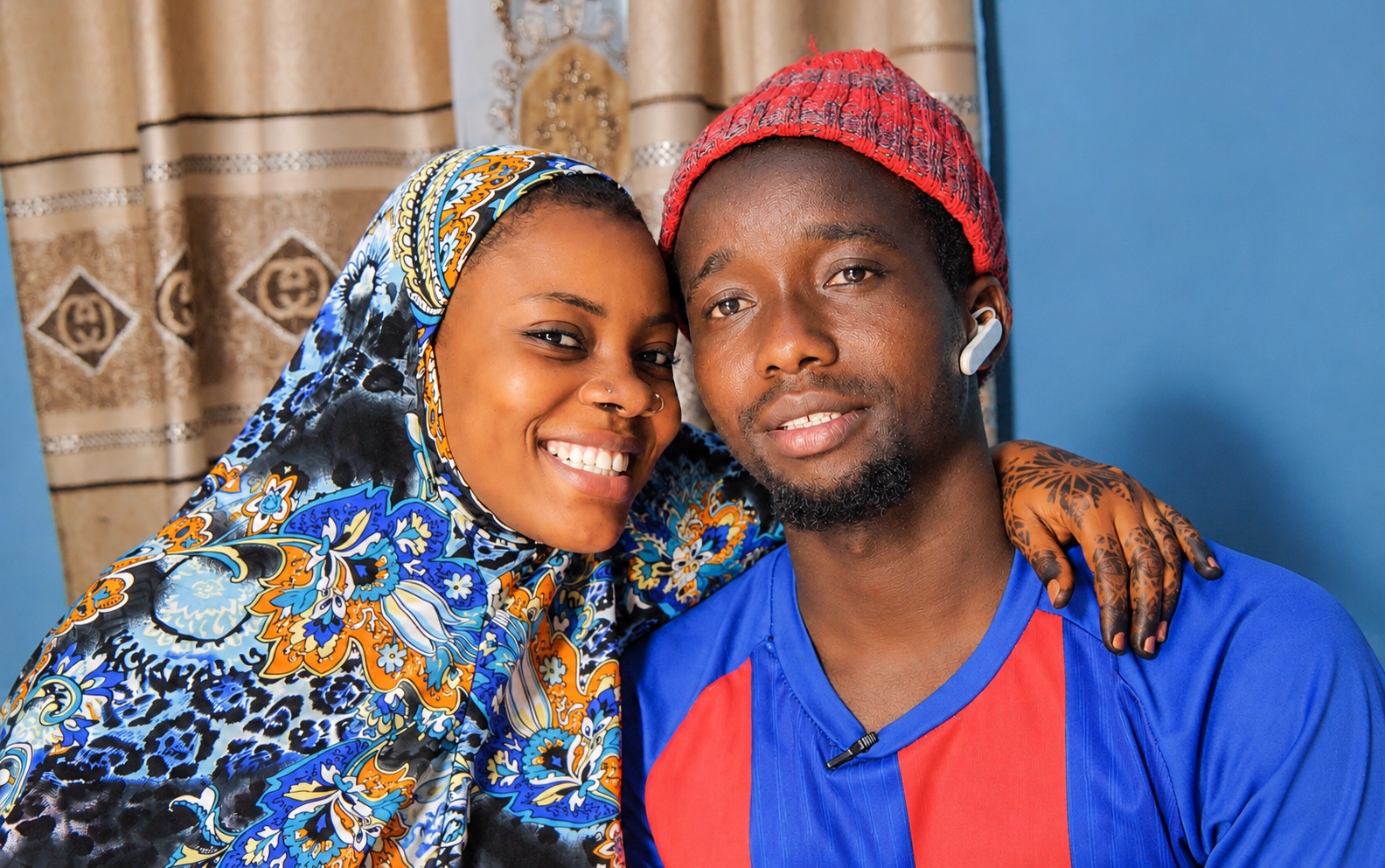
For many young couples, marriage is a celebration of love, commitment, and the beginning of a new life together. But for Alpha Conteh, a young farmer and taxi driver in his early thirties from Sabi Village in Upper River Region (URR), the journey to marry the girl he loves was a painful struggle against a deeply rooted caste and descent-based discrimination system.
Alpha, is regarded as belonging to the so-called ‘lower caste’. He fell in love with Aramata, a young girl in her mid-twenties from a family considered to be of the ‘upper caste’. Their relationship, which was built on love pure and simple, was met with fierce resistance from the community because of the social statuses they inherited.
“It was on a particular day when I met Aramata and asked her if she was married. She replied in the negative. We exchanged telephone numbers and then started talking thereafter. As we got to know each other, we agreed to spend our lives together,” Alpha recalled.
As dictated by Sarahule tradition, Alpha informed his family of his intention to marry Aramata. His parents bought cola nuts, a customary symbol of respect and announcement of a person’s marriage intention, and visited Aramata’s family to formally seek her hand in marriage for their son.
Unfortunately, Aramata’s family rejected the proposal on the sole reason that it would be beneath their status for their daughter, who is from the 'noble' class, to marry a man from a lower caste.

“They told my family that they could not allow the marriage because I am from the Conteh clan, which they considered to be from the ‘slave’ caste, while Aramata comes from the ‘noble’ caste. It was painful because they were rejecting me because of the family I was born into,” Alpha bemoaned.
Aramata, aware of the resistance of her parents, sought the support of her relatives, including her uncle, so that they could mediate on her behalf and dissuade the parents from their position.
“I tried everything I could. I spoke to my uncle and other family members, but nothing changed. No matter what we said, they refused to accept our decision,” she stated.
With no progress despite different efforts, Aramata and Alpha turned to the National Human Rights Commission (NHRC) Regional Office in Basse for assistance.
“We went to the Human Rights Commission and explained everything we were going through. The officers listened to us and visited Aramata’s parents to engage them, but they still refused to accept the marriage,” Alpha explained.
Alpha’s story mirrors the findings of the National Human Rights Commission’s 2022 Study on Caste and Descent-Based Discrimination in The Gambia which shed light on a long-standing human rights issue that continues to affect some communities, especially in Upper River Region (URR).
The Study revealed that since 2018, there have been recurring tension in some Sarahule communities in URR, linked to divisions between those regarded as ‘nobles’and socially ‘superior’ and those labelled as descendants of ‘slaves’ and are treated as inferior. Individuals perceived to belong to the so-called ‘lower caste’ are often subjected to degrading and dehumanizing treatment.
After a thorough assessment of Alpha and Aminata’s case at the NHRC Office in Basse, Mr. Momodou Lamin Badjie, NHRC Regional Investigation Officer for CRR and URR, visited Aramata’s family to engage them in a dialogue.
“When we visited Aramata’s family in Kumbija Village in URR, we talked to them about the law and made them to understand that discrimination based on caste is strongly prohibited by law. However, the family still insisted that there cannot be any marriage between Aramata and Alpha,” stated Mr. Badjie.
Instead of helping to soften the position of the parents, the visit by the NHRC triggered a violent reaction.
“After the human rights people left, my father and my elder brother beat me seriously because they said I had involved the Human Rights Commission,” Aramata recounted. “They even wanted to marry me off to another member of my caste who had paid the dowry and did all the rites required. I refused to give in to their arrangement. Finally, my parents returned the dowry to the man,” she explained.
The NHRC continued its intervention by engaging relevant stakeholders, including Gambana, a Sarahule association advocating against caste and descent-based discrimination, and the Cadi Court. Through many other dialogue and mediation sessions with the parents, the marriage finally took place between Aramata and Alpha.
The process of the marriage between Aramata and Alpha, which began in 2023, lasted nearly three years.
“It was not easy. At one point, Aramata’s parents even took me to the Police Station and warned me to leave their daughter alone,” Alpha said.
Alpha expressed deep appreciation for the role played by the NHRC. Although the marriage marked a significant victory for the couple, Alpha’s reconciliation with Aramata’s family remained difficult.
After the wedding, Aramata visited her family compound while her father was away. Unfortunately, she was also not welcomed. Her mother ignored her greetings.
“My mother told me that she would only reconcile with me if I leave Alpha and end the marriage. I told her I will never do that,” Aramata said.
Over time, the relationship with her mother gradually improved.
“My mother eventually started talking to me again, but my father still refuses to accept my decision,” she remarked sorrowfully.
Despite the continued resistance from parts of her family, Alpha and Aramata remain committed to each other, and are blessed with their first child.
Regrettably, these harmful perceptions continue to persist in some communities today.